
US Secretary of State Marco Rubio has said that the US is ready to sell as much energy as India is willing to buy. He described India as a 'great partner' ahead of his visit to New Delhi.

Indian Oil Corporation has approached the petroleum ministry with a proposal to raise oil prices by Rs 5.29 a litre and diesel by 4.54 a litre in line with the price band formula worked out by the government.\n\n

Iranian Foreign Minister Abbas Araghchi is in India for a BRICS foreign ministers' meeting, where discussions will focus on the escalating crisis in West Asia and its impact on global energy supply chains.

The rupee appreciated 53 paise to close at 89.67 against the US dollar on Friday, supported by corporate dollar inflows and easing crude oil prices. Forex traders said a positive trend in domestic equities and Brent crude oil prices hovering near $59 per barrel supported the domestic unit at lower levels.

Why would a country that requires close to $90 billion in net foreign capital annually to create jobs, build productive capacity, and sustain rapid growth permit $30 billion of capital to flow abroad, thereby contributing to pressure on the rupee? asks Debashis Basu.
Government will review fuel pricing scenario in October, Petroleum Secretary M S Srinivasan said on Thursday. The petroleum secretary further said, "Situation will be revisited in October when we will take stock of the scenario emerging out of international oil prices." Global crude prices touched a record $145 a barrel, which is expected to push India's oil import bill this year higher by nearly 76 per cent to $110-120 billion.

India, the world's third-largest oil consumer, spent 2.5 billion euro on buying crude oil from Russia in September, 14 per cent less than the previous month, a European think tank said. India remained the second-largest buyer of Russian fossil fuels in September behind China, according to the Centre for Research on Energy and Clean Air (CREA).

Even if there is an early agreement on a cessation of hostilities in West Asia, the price shock will not go away easily, points out A K Bhattacharya.

The Indian government has increased import duties on gold and silver from 6 per cent to 15 per cent to curb inbound shipments of precious metals amid a rising import bill due to the West Asia crisis.

Households should moderate large discretionary expenses for the time being.
'They should prioritise essential spending. They should maintain an emergency fund covering 6 to 12 months of expenses.'

The dollar devaluation has seen revenue loss incurred by state-run oil firms on fuel sales trimming to about Rs 96 crore per day.
Finance Minister P Chidambaram on Monday said the surge in international oil prices is a matter of grave concern and it was for the petroleum ministry to take a call on retail pricing of petroleum products.
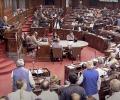
Opposition MPs in the Rajya Sabha criticised the Modi government's economic policies, citing the LPG crisis, lack of energy security, and concerns over the Economic Stabilisation Fund.

Former US President Donald Trump claimed that Iran has agreed to return its "nuclear dust" to the United States as part of broader assurances not to pursue nuclear weapons. He expressed optimism about ongoing negotiations and a potential deal.
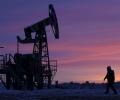
International oil prices jumped to the highest level since 2014, topping $87 a barrel but domestic petrol and diesel prices remained unchanged for the 74th day in a row - a freeze that may be linked to ensuing assembly elections in states like Uttar Pradesh and Punjab. Brent - the key global oil benchmark - soared to $87.7 per barrel mostly due to rising geopolitical tensions and supply-side disturbances due to Yemen's Houthi group's attack on oil facilities in the United Arab Emirates. Also, global inventories are waning. The attack, some analysts believe, may lead to more hostile behaviour between the two power centres in the Middle East - Iran and Saudi Arabia.

Amid rising tensions in West Asia, China is urging all parties to cease military operations, following Trump's appeal for help in securing the Strait of Hormuz.

Economics and politics both have major roles in determining oil prices.

'The West Asia or the Gulf crisis has shown that what we develop as national infrastructure when things are not as bad as they could be, we forget to plan for adversities.'

An Iranian tanker successfully bypassed the US Navy to deliver crude oil to the Asia-Pacific region, despite ongoing tensions and a US blockade.
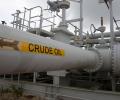
India has gained the least since Russia invaded Ukraine in February 2022 and was penalised the most, while the US, China and the European Union emerged as the biggest beneficiaries from the war.
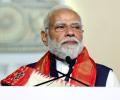
Congress leader Rahul Gandhi has criticised Prime Minister Narendra Modi's call for citizens to make economic sacrifices in response to the West Asia conflict, calling it 'evidence of failure'. Gandhi accused Modi of shifting responsibility onto the public and being incapable of running the country.

Despite a ceasefire agreement between Iran and the United States, the Strait of Hormuz remains blocked due to Iran's inability to locate and remove all the mines it laid during the conflict, hindering global oil and gas supplies.

...reopen for up to six months. Until then, the Strait stays nearly closed. The world pays. And no one, including the man who started this, can say when it ends, notes Prem Panicker in his must read blog on the Iran War.

India's sugar consumption is projected to fall by nearly 400,000 tonnes in the 2025-26 season, primarily due to the ongoing liquefied petroleum gas (LPG) shortage exacerbated by the West Asia conflict and unseasonably cool weather.

The proposed facility seeks to simplify and speed up PF withdrawals by allowing Employees' Provident Fund Organisation (EPFO) subscribers to access up to 75 per cent of their balance through ATMs and UPI-based systems, while retaining at least 25 per cent in their accounts.
Soft oil prices are expected to persist in 2015 and will be accompanied by significant real income shifts from oil-exporting to oil-importing countries.

Crude oil has fallen about 40 per cent since mid June and the price on Monday touched its lowest level since mid 2009 before US oil prices posted their biggest one-day gain in two years overnight.

Unless there is a sharp uptick in oil prices, Fed may push back rate hike
The Iran conflict led to a sharp correction in Reliance Industries Ltd's (RIL's) share price, which has been partially reversed by a rebound.

A United States missile strike has reportedly hit an educational facility in Khomeyn in central Iran, according to a report by Al Jazeera citing Iran's Mehr news agency. The site was identified as the Dr Hafez Khomeyni School.
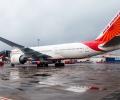
Indian carriers have cancelled over 10,000 flights since the onset of the West Asia conflict, as escalating tensions and airspace restrictions disrupted international operations, a senior government official said.

India's private sector activity saw a significant recovery in April, driven primarily by robust growth in manufacturing output and sales, following a three-year low in March attributed to the West Asia conflict.
If the global economy slows down or slips into a recession due to high oil prices, that will eventually hurt all of us.
The banking sector in the country is stable, capital is available and credit offtake is poised to take off, he said at a webinar organised by Bharat Chamber of Commerce. "We are not unique to the phenomenon of uncertain growth and high inflation due to the pandemic.
The interest of the poor can be protected by providing targeted subsidy, Planning Commission's Deputy Chairman Montek Singh Ahluwalia said, adding that increased energy cost would have to be shared by the consumers as the burden is currently being largely borne by public sector oil companies.

Despite the recovery to above $40 levels after hitting $28-29 in Jan, worries of over-supply in the face of weak demand remain.

State-owned Life Insurance Corporation of India (LIC) has reported a net profit of over Rs 23,400 crore for the January-March quarter, making it the highest profit-making firm in the Indian financial sector during this period, surpassing major banks like SBI and HDFC Bank.
Crude oil price of $50 a barrel in the international market would pull down India's GDP growth by 0.4 per cent and push up inflation by 1.5 per cent, a FICCI study has said.
